

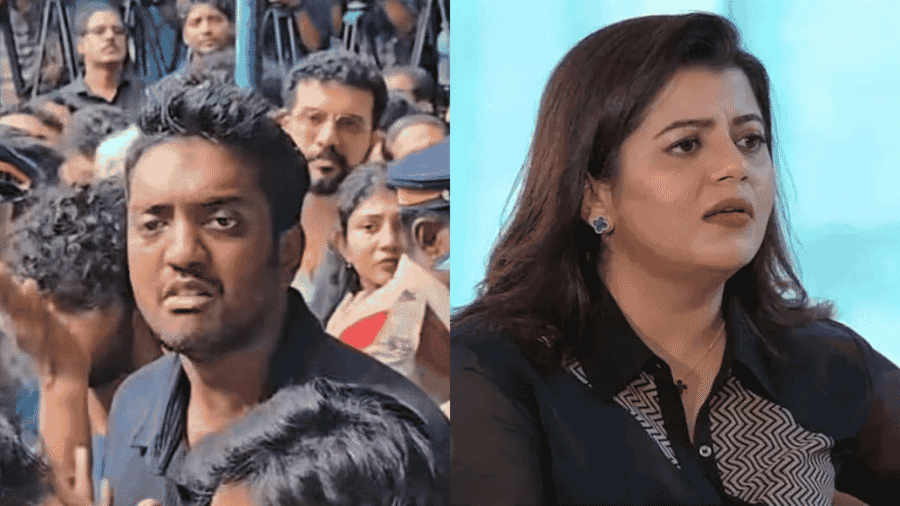
Former journalist and film producer Supriya Menon has sharply criticised the behaviour of online media outlets and YouTube channels at the funeral of veteran actor Salim Kumar. The National Award winner died on Saturday at the age of 56 and was laid to rest with state honours at his residence, Laughing Villa, in North Paravur. The occasion was disrupted when a crowd of content creators and photographers pushed into the family’s space, and videos of the resulting confrontation spread quickly on social media.
The flashpoint came during the final rites, when Salim Kumar’s son, Chandu Salim Kumar, was seen shielding his family and repeatedly asking reporters to step back so they could mourn in some privacy. The footage drew widespread criticism of media outlets prioritising views over basic empathy.
‘This is not journalism’
Writing on social media, Supriya Menon — a former correspondent for the BBC and NDTV — described the scene as a moment of grief overrun by cameras and microphones jostling for a final close-up. Pointing to Chandu’s appeals for space, she said the urge to film raw personal tragedy in real time abandoned any sense of decorum.
She was clear that such coverage cannot be defended as reporting, calling it exhibitionist and unnecessary, and urged creators to show restraint and let families grieve without becoming a spectacle. She noted this was not the first time she had raised the issue, having spoken out earlier at the funeral of veteran actor Sreenivasan, where the rush for selfies and soundbites had similarly overshadowed the occasion.
Calls for clearer rules
Her comments fed into a wider debate in Malayalam cinema about how freely online vloggers and news operators are allowed to work. Many technicians, writers and viewers backed her, with some calling on bodies like the Kerala Film Producers’ Association and the Film Employees Federation of Kerala to set firm limits keeping digital crews out of private cremations and mourning homes. Online, there were calls for legal measures against platforms that breach privacy during family crises.
Some observers pointed out that the industry itself often relies on these same platforms for promotion, but the broader view was that a person’s final journey should be off limits. As Kerala continues to mourn Salim Kumar, the episode looks likely to push a shift in how such events are covered.


Leave a Reply